Can Iron Deficiency Cause Irregular Periods?
If your periods have suddenly become irregular and you are also dealing with tiredness, weakness, dizziness, or unusually heavy bleeding, you may wonder whether low iron is responsible.
The answer is more nuanced than a simple yes or no.
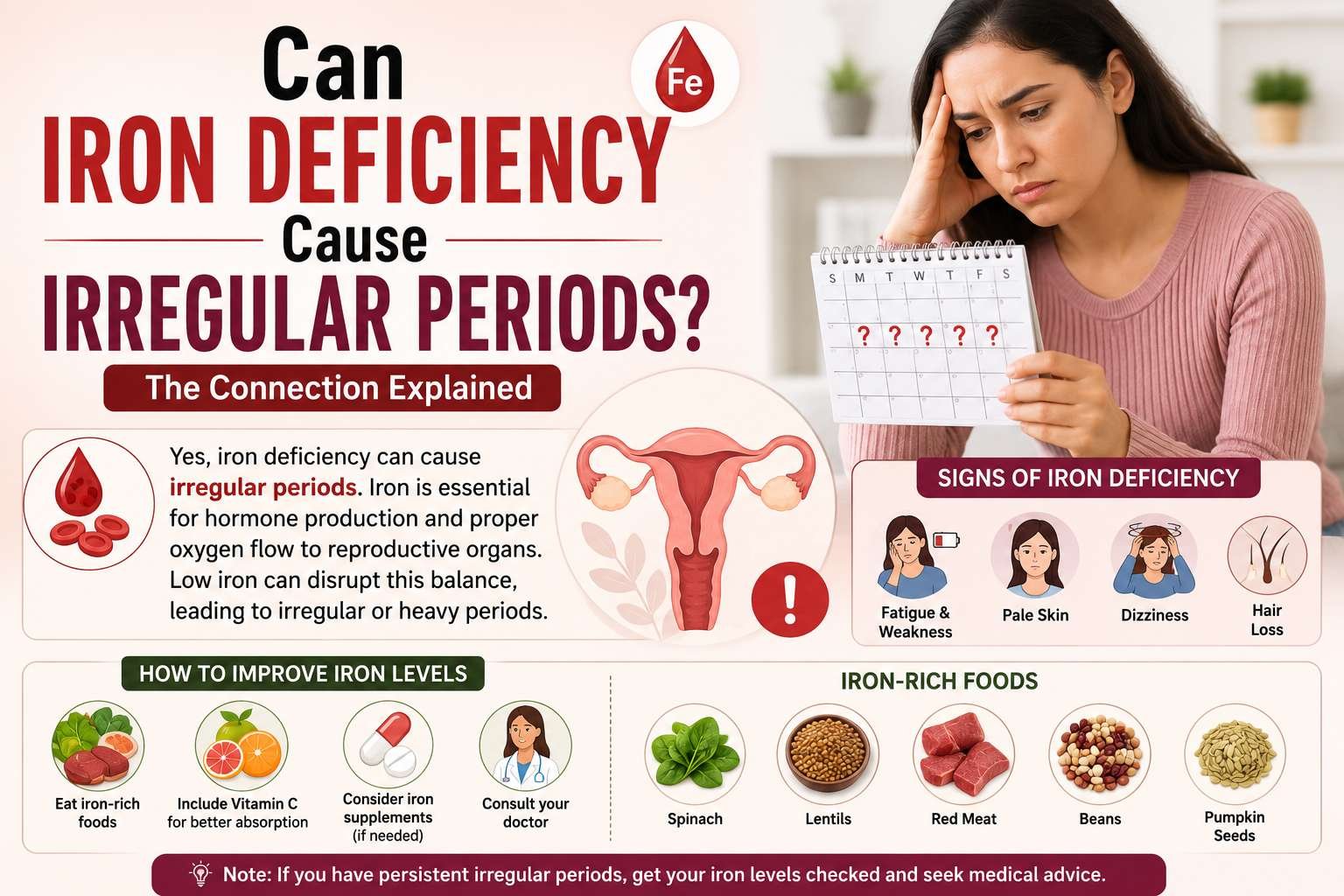
Iron deficiency is common among women of reproductive age, particularly when menstrual blood loss is heavy. However, current evidence does not support treating iron deficiency as a universal or proven direct cause of irregular menstrual cycles. In many cases, the relationship works in the opposite direction: heavy or prolonged menstrual bleeding can lead to iron loss, which may eventually cause iron deficiency and iron-deficiency anemia.
Understanding this difference is important because irregular periods can have many other causes, including PCOS, thyroid disorders, pregnancy, hormonal changes, excessive exercise, nutritional deficiencies, and certain medicines.
Iron Deficiency vs. Iron-Deficiency Anemia
Iron deficiency means the body's iron stores are becoming low. At this stage, hemoglobin can still be within the normal range.
When iron deficiency becomes severe enough to reduce hemoglobin production, it can develop into iron-deficiency anemia (IDA).
This distinction matters because a normal hemoglobin result does not always rule out depleted iron stores. Depending on the symptoms and clinical situation, a healthcare professional may consider tests such as a complete blood count (CBC), ferritin, and other iron studies.
Can Iron Deficiency Actually Cause Irregular Periods?
There is a strong and clinically recognized relationship between heavy menstrual bleeding and iron deficiency. Reviews of clinical guidelines consistently identify heavy menstrual bleeding as an important cause of iron deficiency and, in more severe cases, iron-deficiency anemia.
The evidence is less clear when the question is whether iron deficiency itself directly causes irregular periods.
So, if someone has irregular periods and low iron, it would be inaccurate to automatically conclude that the low iron caused the irregular cycle. The two conditions may coexist, or the menstrual problem itself may have contributed to the iron deficiency.
For example:
Heavy menstrual bleeding → greater iron loss → depleted iron stores → iron deficiency → possible iron-deficiency anemia
This pathway is better supported by current evidence than the claim that iron deficiency directly causes irregular periods.
Why Can Periods Become Irregular?
Menstrual cycles are regulated by a complex interaction between the brain, pituitary gland, ovaries, and reproductive hormones. A change anywhere in this system can affect ovulation and menstrual timing.
Common causes of irregular periods include:
-
Pregnancy
-
Polycystic ovary syndrome (PCOS)
-
Thyroid disorders
-
Elevated prolactin levels
-
Perimenopause
-
Excessive exercise
-
Significant weight loss or inadequate energy intake
-
Hormonal contraception
-
Certain medicines
-
Some medical or gynecological conditions
Therefore, recurring irregular periods should not automatically be blamed on iron deficiency.
Heavy Periods Can Increase the Risk of Iron Deficiency
This is where iron and menstrual health are strongly connected.
Blood contains iron, so repeated heavy menstrual bleeding can gradually reduce the body's iron stores. A woman may initially have low iron stores without anemia. If blood loss continues, hemoglobin may eventually fall and iron-deficiency anemia can develop.
Possible symptoms include:
-
Persistent tiredness
-
Weakness
-
Dizziness
-
Reduced exercise tolerance
-
Shortness of breath, particularly when anemia is significant
-
Headaches
-
Difficulty concentrating
-
Pale-looking skin
-
Feeling unusually exhausted during or after periods
These symptoms are not specific to iron deficiency, so testing and medical assessment may be needed rather than relying on symptoms alone.
What Tests Can Help?
If you have heavy periods, persistent fatigue, or other risk factors for iron deficiency, a healthcare professional may recommend blood tests.
1. Complete Blood Count (CBC)
A CBC helps assess hemoglobin and other blood-cell parameters and can identify anemia.
2. Serum Ferritin
Ferritin is an important marker of stored iron. A low ferritin level can indicate depleted iron stores.
However, ferritin should be interpreted in context because inflammation and some other conditions can affect ferritin levels. There is no single ferritin number that should be presented as an “optimal menstrual health” target for every woman.
3. Other Iron Studies
Depending on the clinical situation, a doctor may also consider serum iron, transferrin saturation, or total iron-binding capacity (TIBC).
The right tests depend on symptoms, medical history, menstrual bleeding pattern, diet, and other risk factors.
Can Iron Supplements Make Periods Regular?
Not necessarily.
If a woman has confirmed iron deficiency, appropriate iron replacement can help restore iron stores and treat iron-deficiency anemia. But if irregular periods are caused by PCOS, thyroid dysfunction, pregnancy, hormonal problems, or another condition, treating iron deficiency alone will not address the underlying cause.
This is why taking iron supplements simply because periods are irregular is not always appropriate. The cause should be assessed first.
Iron supplements can also cause side effects such as constipation, nausea, abdominal discomfort, or dark stools, and unnecessary supplementation is best avoided.
How Can Diet Support Iron Intake?
A balanced diet can help maintain adequate iron intake.
For vegetarians, useful sources include:
-
Lentils and dals
-
Chickpeas
-
Rajma and other beans
-
Soy foods
-
Sesame seeds
-
Green leafy vegetables
-
Iron-fortified foods
Plant-based iron is non-heme iron, and its absorption can be influenced by the overall meal. Vitamin C-rich foods such as amla, lemon, guava, tomatoes, and citrus fruits can help improve non-heme iron absorption.
Tea and coffee contain compounds that can reduce non-heme iron absorption when consumed with meals. If you are being treated for iron deficiency, ask your healthcare professional about the appropriate timing of tea, coffee, calcium, and iron supplements.
What Does Ayurveda Say About Menstrual Health?
Ayurveda describes menstruation through the concept of Artava and discusses normal menstruation as well as different menstrual disorders. Classical Ayurvedic literature considers the menstrual process within a broader framework involving Artava, Rakta, Dosha, and reproductive physiology.
The Charak Samhita Research, Training and Development Centre describes Artava as a term used in Ayurveda for menstruation and menstrual fluid, and explains menstrual disorders through concepts such as decreased, increased, or disturbed Artava.
Ayurvedic descriptions should not, however, be treated as direct equivalents of modern laboratory concepts such as ferritin or hemoglobin. Modern medicine measures iron deficiency using blood tests, while Ayurveda approaches menstrual health through its own classical framework.
This distinction is important: Ayurvedic concepts and modern biomedical diagnoses should not be presented as interchangeable.
Ayurvedic diet and lifestyle principles may be discussed as supportive approaches to overall wellbeing, but significant anemia, very heavy bleeding, or persistent menstrual irregularity should not be managed by delaying appropriate medical evaluation.
When Should You See a Doctor?
Speak with a healthcare professional if your periods remain irregular for several cycles or if you experience:
-
Very heavy menstrual bleeding
-
Bleeding lasting longer than usual
-
Bleeding between periods
-
Bleeding after sex
-
Severe pelvic pain
-
Repeated dizziness or fainting
-
Significant weakness or breathlessness
-
Several missed periods
-
A sudden major change in your usual cycle
-
Possible pregnancy
Very heavy menstrual bleeding can sometimes be associated with conditions such as fibroids, adenomyosis, PCOS, bleeding disorders, or other gynecological problems. Finding the cause is more useful than assuming that iron deficiency is responsible.
The Bottom Line
Iron deficiency and menstrual health are closely connected, but the relationship should be understood correctly.
Heavy or prolonged menstrual bleeding can cause substantial iron loss and may eventually lead to iron deficiency or iron-deficiency anemia. However, iron deficiency should not automatically be considered a proven direct cause of irregular periods.
If you have irregular periods together with fatigue, weakness, or heavy bleeding, the sensible approach is to look at the complete picture: menstrual pattern, pregnancy possibility, hormonal and gynecological causes, diet, symptoms, and—when appropriate—CBC and ferritin testing.
Treating confirmed iron deficiency is important, but treating the underlying reason for irregular periods is equally important.
References
-
ACOG — Abnormal Uterine Bleeding: https://www.acog.org/womens-health/faqs/abnormal-uterine-bleeding
-
ACOG — Screening and Management of Bleeding Disorders in Adolescents With Heavy Menstrual Bleeding: https://www.acog.org/clinical/clinical-guidance/committee-opinion/articles/2019/09/screening-and-management-of-bleeding-disorders-in-adolescents-with-heavy-menstrual-bleeding
-
NICHD — Causes of Menstrual Irregularities: https://www.nichd.nih.gov/health/topics/menstruation/conditioninfo/causes
-
PubMed — Review of Clinical Guidelines on Iron Deficiency and Iron-Deficiency Anemia in Women With Heavy Menstrual Bleeding: https://pubmed.ncbi.nlm.nih.gov/33247314/
-
Charak Samhita Research, Training and Development Centre — Artava: https://carakasamhitaonline.com/index.php/Artava
-
Charak Samhita Research, Training and Development Centre — Menstrual Disorders: https://www.carakasamhitaonline.com/index.php?title=Menstrual_disorders
Medical disclaimer: This article is intended for general health education and does not replace diagnosis or treatment from a qualified healthcare professional.
Frequently Asked Questions

Related Articles